

Echos of Altay - Summer
At the beginning of May, as I was preparing for my trip, my younger daughter Sarah came into the room and asked, "How long, Mama?"
"Seven weeks," I replied.
"Is that as long as last time?" she asked, her eyes wide with concern.
I paused, taking a deep breath before answering, "It's longer than that, I'm afraid." With that, she turned and ran out of the room, leaving me alone with my feelings.
After arriving in Almaty, I took a few days to rest before resuming my journey to Urumqi, Xinjiang, China.
Everything was going according to plan.
Before starting my travels, I had heard many rumors about how dangerous it was to visit this particular part of China. People warned me that authorities would thoroughly check everything and copy all data to their systems. If they found anything political against their government, I might end up in jail, even though I had no such intentions and my work has nothing to do with politics.
Despite my fears, I was determined to go.
Finally, I arrived at Urumqi airport. Upon encountering local Chinese immigration officers my heart raced with all the thoughts and warnings I had heard. After waiting in line, in a long line, it was my turn to pass through immigration. To my surprise, the officer spoke fluent English and was very polite. She asked me a few routine questions, typical of any immigration officer in a foreign country, and I was cleared to proceed.
Finally, I arrived in the city of Urumqi.
After settling into my hotel, I visited several local Kazakh households and eventually met the woman who would serve as my guide for the trek toward the Altay Mountains.
The landscape was unlike anything I had ever seen in my life – a stunning desert whose colors shifted constantly in the distance as we drove. The weather was sweltering, around 35°C, and with the air conditioning broken, we faced a 700km drive in a verifiable sauna to reach our destination. Our goal was a nomad's house, home to 400 camels, situated in the desert and surrounded by four Kazakh tents (Kigiz Uy). Along the way, we didn't eat; instead, we drank bottle after bottle of water to stay cool and hydrated.
The warm welcome and smiles of the Kazakh people instantly dissolved the hardships we had faced to get there. As the evening set in, I noticed an outdoor stove with a large pot of meat simmering alongside boiling milk tea, awakening a deep hunger within me.
Before the food was served, the owner played a traditional Kazakh instrument, the Dombra, while the lady of the house captivated us with stories from their day among the camels. Outside, the camels grunted, and a kitten snuggled up beside me, inviting a gentle touch. Overwhelmed with joy, I eagerly devoured the meat as soon as it was served. Afterwards, the lady offered us camel milk to drink.
Once again, the dinner table made me feel Kazakh; perhaps even more than I actually am.
I had hoped to get a good night's sleep before sunrise, but it turned out to be the day they separated the baby camels from their mothers. Unlike horses, which can remain relatively quiet, camels grunt continuously, day and night. The owner mentioned that this usually lasts for about three to four days. Given that the tents were situated so close to the camels, a full night's sleep seemed impossible. I doubt I managed more than two hours, as the grunting – and particularly, the eerie, sharp noises some of them made – sometimes felt like something out of a horror movie. My guide was also awake at four in the morning and smiled at me, saying, "What a night, right?" she added, "In my dream, a dinosaur was chasing me, trying to gobble me. When I woke up in shock, I realized it was just the camels' noise." We both laughed loudly together at the absurdity of it. They milk their camels twice a day and sell the milk to a nearby collection company. Despite the hard work, they earn a good income from it and live quite comfortably.
Camels, known for being slower, are generally easier to photograph. However, caution is still necessary. It's particularly risky to approach a male camel when he is agitated, as he may attack, much like wild male horses.
After breakfast, we set off for Khom, a beautiful valley in the Altay Mountains. The journey covered another 700 kilometers, but the stunning landscape of mountains and forests, a stark contrast to the desert, made our trip more bearable, especially in a car without air conditioning.
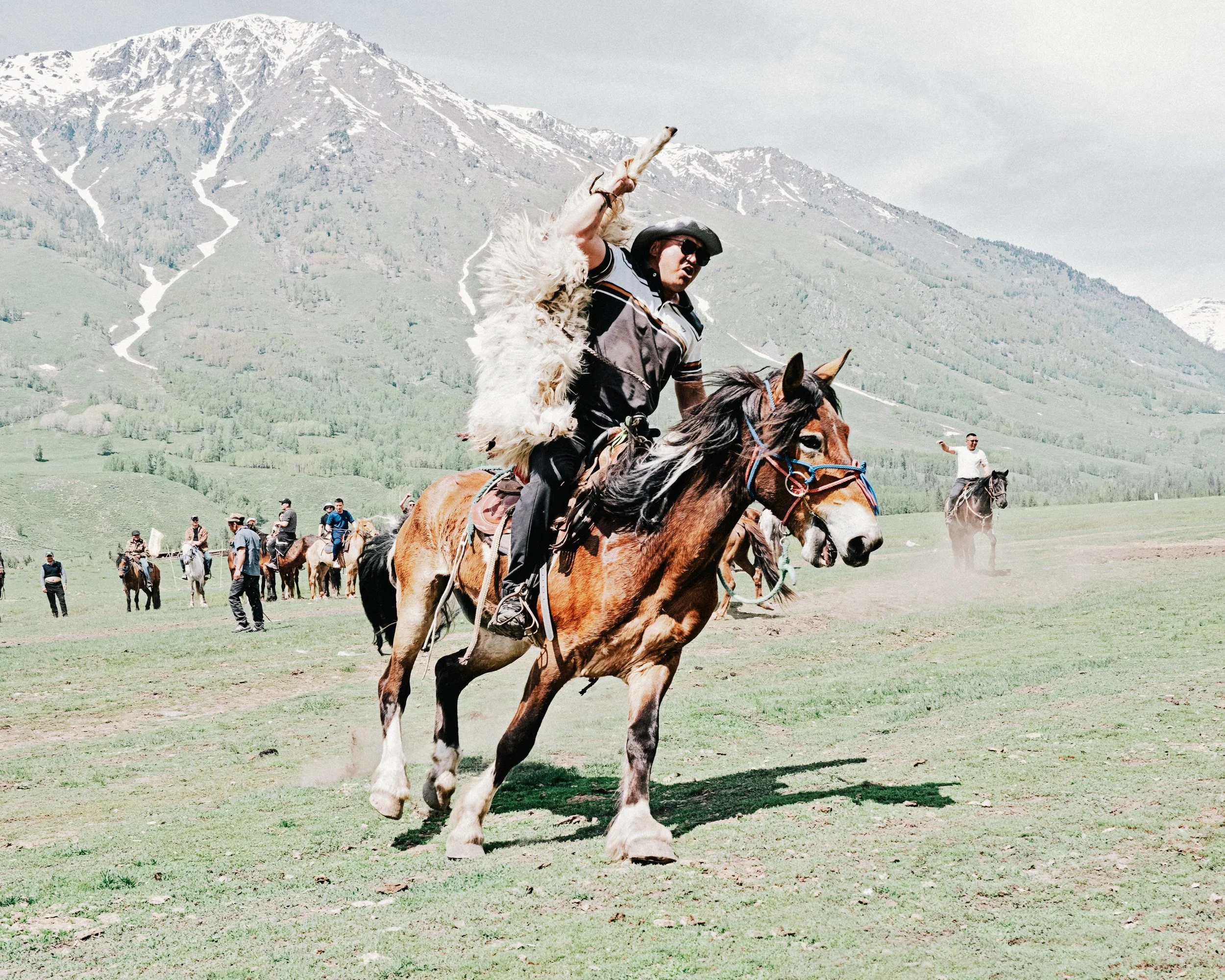
When we arrived, we unexpectedly came across a Nauruz celebration, which takes place on the second day. Kazakh New Year usually falls on March 21st. However, due to the region's cold climate, the event had been postponed to mid-May. It wasn't part of our original plan, but we were thrilled to stumble upon such a festive occasion.
No Nauruz celebration would be complete without the traditional horse games that are central to Kazakh culture. Among these is Kökpar, a vigorous contest where participants battle to seize a headless goat, each striving to claim the prize for themselves. Another highlight is Bayge, a race featuring specially bred sport horses. These horses are meticulously cared for and ridden by young boys aged six to nine. Both horse and rider are usually slim, a combination that enhances the horse’s speed.
Additionally, there's the exhilarating Kiz Khuar, where women on horseback chase the men on horseback, attempting to snatch their hats. Those who participate in this event, especially the women, are typically highly skilled riders. The skill and bravery displayed in these games are a testament to the vibrant and enduring equestrian traditions of the Kazakh people, making the Nauruz celebration a deeply immersive and unforgettable experience.
Language is a powerful connector.
Upon realizing that we spoke Kazakh, the locals immediately welcomed us to join them at their table, where we enjoyed a delicious meal accompanied by music and dancing with local Kazakhs and Tuvas.
After spending three nights in a beautifully decorated wooden house, I was satisfied with the photos I had taken. Feeling content, my guide and I then headed back to Urumqi.
After arriving in Urumqi, I spent two more days exploring the city's diverse culture and cuisine. The streets were extremely crowded, and I was struck by the sheer number of security cameras everywhere. Coming from Germany, where data protection and privacy is a priority, I found the surveillance somewhat irritating. However, as I was walking around alone, the omnipresence of cameras also gave me a sense of safety.
Upon arriving in Almaty, I asked my brother to take me to a coffee shop for a good cappuccino and later, to the Paulaner bar in the city for a nice Bavarian beer in the evening. After spending the last two weeks traveling through Xinjiang, China, this brief respite helped me reset. Feeling refreshed, I prepared myself for the long drive back to the village where I had spent the winter.
Knowing the people from before made it easier for me to photograph them again.
Additionally, bringing their father’s printed images in multiple copies delighted them. This was particularly true for the children of the old gentleman who had been hesitant to let me photograph them in the winter. They were concerned I might share the photos on social media platforms like TikTok or Instagram, as many bloggers do. However, this time, after seeing the printed portraits of their father, they invited me into their home to photograph their entire family. The printed images served as a kind of magic key, opening doors that had been closed to me on my first trip, allowing me to take many portraits that I had previously been denied permission to capture.
One of my goals on this trip was to photograph the nomads who migrate to the high mountains for their summer pastures. Unfortunately, due to a recent winter that extended into early-May, complete with snowfall and the grass already flourishing in their usual area, they didn’t see the need to move. However, fortunately, my cousin knew someone who had just relocated to the mountains with his animals. So, we decided to drive 150 kilometers up to that pasture to capture this traditional migration.
There was a wooden hut with two rooms – one is an eating area and other the bedroom.
He welcomed us warmly, immediately brewing tea and preparing bread with Khurt (dried cheese) and some meat. The area was stunning, with tall grass and a variety of wild animals like skunks and foxes. As we sat down for tea, he shared, "It's so nice to have guests. I've been here alone for five days without any mobile signal, so it's refreshing to interact again." He quickly added, "Don't get me wrong, I enjoy the solitude. It's a kind of recovery for me from my social media and phone habits for the next three months."
Reflecting on the past, I mentioned, "I remember when we were kids, we used to see the nomads in their tents with their whole families. They celebrated casually, and you'd always come across many kids playing outside until night."
I then asked, "What happened? Why isn't that possible anymore?"
He explained, "It was a long time ago. Now, the shepherds are mostly on their own in their missions. We don't see our families from the beginning of June until the end of September. We have no choice; the kids have to attend school or join activities in the big cities. Besides, if you tell them there's no internet in the mountains, they surely won't come."
I made some photos of him and his horse.
Right before we departed, he casually asked my cousin if he had his gun with him. He explained, "I don't have it with me, but I have one at home," to which, the shepherd recounted a harrowing experience from the night before. "One of my cattle was crying so loudly. I was in such a rush I didn't even have time to put on my pants. I just grabbed my jacket and torch and ran up the hill barefoot. Initially, I thought it might be a wolf, which I can usually scare away, but it turned out to be a bear – a big one. It was savaging the cattle, biting its leg, and the poor animal was screaming in pain. When the bear saw me with my torch, it paused for a second, then started moving slowly towards me, growling."
"I began to scream like crazy, but I was empty-handed. Just then, my two dogs arrived; they started barking aggressively at the bear, and I screamed even louder. Thankfully, the bear turned and walked away, but unfortunately, I couldn’t save my cattle." He then added, "That's why I'm asking for a gun." We left promising to bring him one.
While we were in the car, I asked my cousin what would have happened if he had had a gun during the bear encounter. "Would he have killed the bear?" I inquired. He explained, "No, they wouldn't die because we use tranquilizer guns. The animal would just faint, and most likely, get scared, and that would deter them from coming close to the animals and people again."
The landscape had transformed dramatically since my winter visit; it possessed a different kind of beauty, though I personally preferred the more melancholic and poetic winter scenery.
We continued our drive to visit a family living well beyond the village. They have many horses and other animals but tend to stay in one location rather than moving frequently like other nomadic groups. The journey to their home was an adventure in itself due to the lack of proper roads, yet I was keen on making the visit.
Along the way, I made it a habit to drink lots of water because the altitude and thin mountain air tends to dehydrate one quickly.
We arrived around sunset, and I soon felt the urgent need to use the toilet. As I was contemplating this, six large Kazakh dogs (Alabais) approached the car. I admitted to my cousin that I was frightened of these dogs, but he helped me get into the house safely.
Stepping inside, it felt as though I had traveled back in time. The house appeared quite old-fashioned from the outside, reminiscent of the 1930s, yet the interior was immaculately clean and well-organized.
Despite the urgency, I remembered that the toilet was located about 80 meters from the house. In Kazakh culture, it’s not customary to ask a man other than your husband or son to accompany you to the toilet for reasons of politeness, so I hesitated to ask my cousin for assistance, but I was suffering.
The lady of the house was very kind and prepared tea for us along with other Kazakh delicacies. In this culture, it's important to accept such offerings; declining the tea could be seen as a lack of appreciation, or even a slight. Moreover, since I had come from Germany, there was a concern that they might think I was unable to accept or appreciate their hospitality due to differing standards. Given the circumstances, I accepted the tea to show my appreciation for the host's kindness. Later, when we decided to step outside using our phone lights for illumination, the dogs immediately approached us, which was quite intimidating. Concerned about the long drive back with a full bladder and the discomfort it would cause, I politely asked the lady of the house if she could accompany me to the toilet. She graciously agreed, and I felt a great sense of relief.
Since I couldn't take photos the previous day, we decided to return to the same family. However, the landlady politely requested that I not take pictures of them. She explained that they preferred to be photographed only when dressed up for weddings or other special events, after preparing themselves with makeup and proper attire. I respected her wishes and instead took photos of the interior and exterior of their home.
This concluded my journey in Akhzhar.
As I made my way back to Almaty, I spent the last few days capturing the majestic Tangertag mountains, each click of my camera shutter preserving the serene beauty around me. My suitcase, brimming with souvenirs and delectable dried fruits from my family, and for my family and friends, was a tangible reminder of the journey. The bittersweet end of my adventure left me with a heart heavy, lightened by the thought of reuniting with my family.
Yet, what I carried most with me was an immeasurable sense of fulfillment, fewer worries, and a newfound courage.
Photography, it seems, is an enchanting addiction.
Before even boarding my flight, my mind was already planning a return – the anticipation of future adventures filling me with an indescribable joy. This time, I envision myself traveling with less apprehension and even more bravery,
The experiences I've gathered are merely chapters in an ongoing story. And so, with a heart full of gratitude and a spirit eager for the next journey, I look forward to the day when I'll once again embrace the wonders of the surrounds of Altay mountains, camera in hand, ready to capture life's fleeting moments. Until then, the memories and dreams will sustain me, bridging the gap between now and the adventures yet to come.
As I take my seat on the plane, I realize this isn't truly an end, but a pause.
